I made a molecular dynamics simulation to understand science of new material discovery
<Work in Progress>
At Comet Aerospace, we are a little early in our journey to be thinking about discovery of new super alloys, but later stage companies like SpaceX have in-house teams that do it.
But anyways I was curious to learn how we would do this 10 years down the line, so I did some digging.
I always used to think that discovery of new materials was a trial-and-error process, and very much luck driven. But I recently learned that there is a method to the madness.
There are two parts to it → Simulations, and practical
PART 1 → Simulations
Let us say we want to reduce the weight of our missile engine’s combustion chamber. For this, we want to find a new metal alloy that maintains a certain tensile strength, at high temperatures of 2000 Celcius +, while having density below a certain threshold.
To begin with, we shall start with a theoretical metal alloy, with consituent elements, that we believe will satisfy the above macroproperties → density, tensile strength, and temperature resistance.
Next, we are going to create an atomic simulation, where the interactions between the consitient atoms are models using quantum interactions.
From this simulation, we are able to derive even things like lattice structure. This is because a given lattice strcuture is the energically most stable configucation for those atoms to reside in.
Note that all macro-properties of a material, are essentially derived from the atomic level interations of constituent atoms.
Example: If you can want to predict macroproperties such a melting point of solids. Recall that temperature of a solid is actually the kinetic energy of the atoms, and in order to simulate “heating” in MD simulations, one can simply increase the kinetic energy of the atoms that are close to a said boundary wall in the simulation construct
Note that in order to predict macroproperties, one needs to create a physics simulation where we have sufficient no of atoms that macroproperties can be observes. For example, you, when deriving tensile strenght, you want a large no of atoms to see how a certain external load moves throughout the material, and not such for a few atoms. The right no of atoms can vary for case to case. but ~100K atoms is usually a good number.
The governining equation for qunautm is the Schreogdinger wave equation, which is O(e^n) exponential in computational complexity. As such, we can’t solve this equation for another other than a simple Hydrogen molecule, let alone 100K atoms of a metal, with 20-30 electrons in each.
Hence, some smart people came up with Density function theory, which is a simplified way to solve Schrodinger wave equation, without compromising the accuracy. This enables us to get to about 1000 atoms.
Next, we digest the results of 1000 atoms into specific constants, which can then be used by simplers models such as leneard jones, which essentially model atoms using newtonian physics. Though the use of GPU’s, we can finally scale to ~100K atoms.
In order to do this, we are going to create a physics simulation where we take a crystal lattice containing say 100K atoms of the constituents. Next we are going to run a molecular dynamics simulation where we see the evolution of the lattice with time.
Steps →
- Quantum DFT
- ML trained potentials
- MD Sims using classical forces
- Scaling using GPU’s
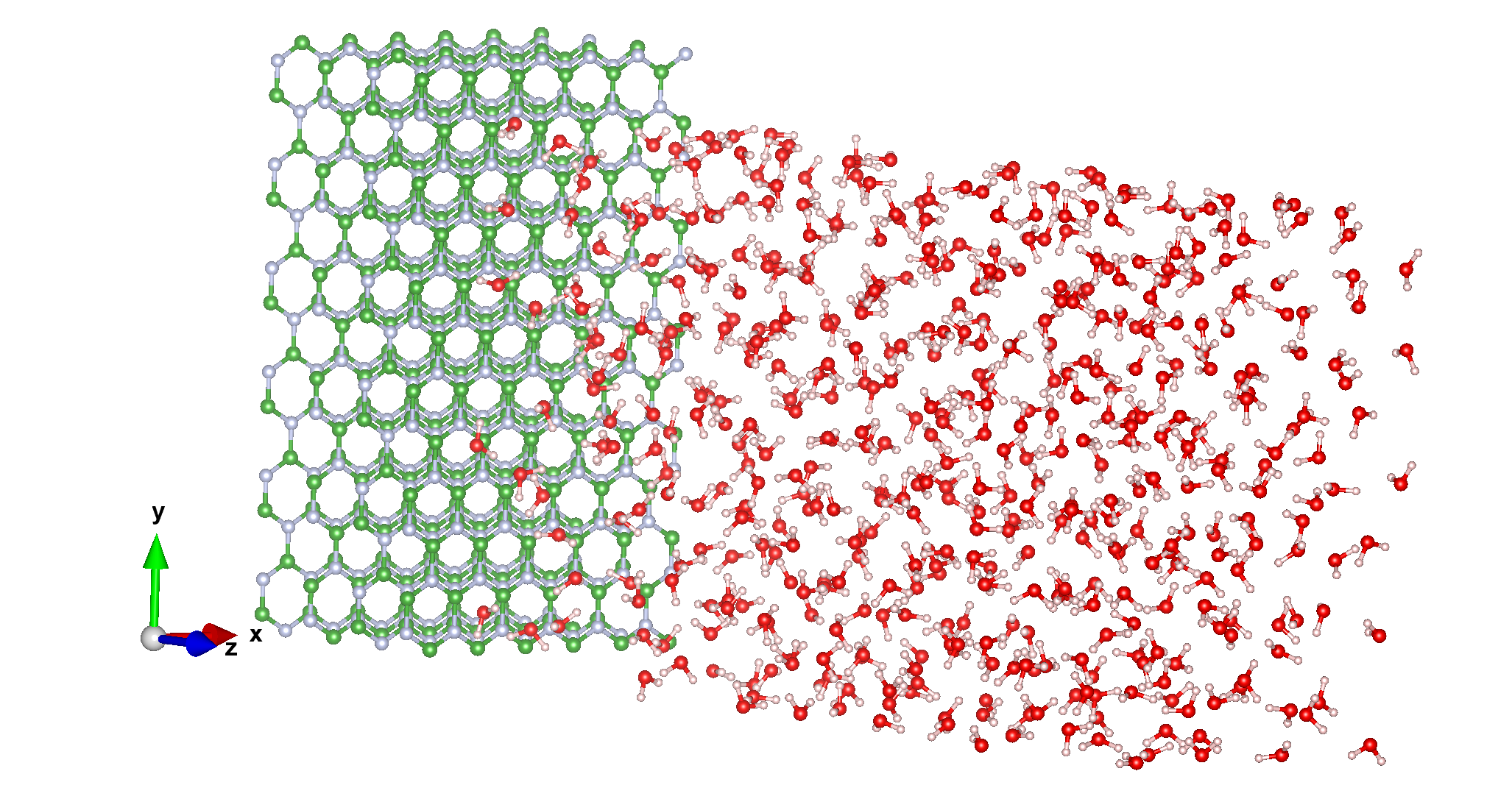
I ran succesful in running a very simple MD simulation where the interation of hBN (hexogonal Boron Nitride) and a liquid is shown (can you guess the liquid?). I must credit Prof Ananth of IISc who helped me setup this simulation.
Part 2 → Practical
So far, we looked at the simulation side. Now we must get into the practical side. How do we know that a given material follows the property as we intended from the simulations? For that we need to “see” the atoms and molecules
This is here X-ray diffraction, crystallography, and synchrotron light sources comes in.
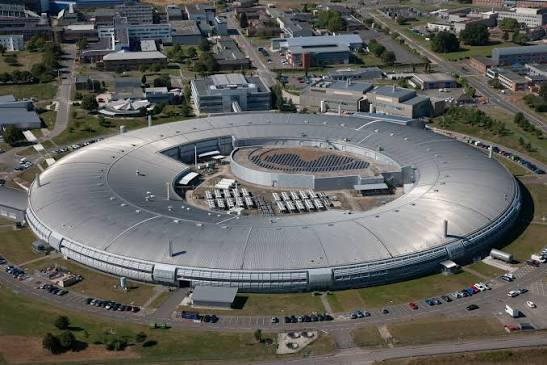
Below is an image of a syncrotron light source. The building is so shaped since it’s a partcle accelerator. Yes, the entire building is one giant machine.