Science of new material discovery happens is crazy!
<Work in Progress>
I always used to think that discovery of new materials was a trial-and-error process, and very much luck driven. But I recently learned that there is a method to the madness.
At Comet Aerospace, we are a little too early in our journey to be thinking about discovery of new super alloys, but later stage companies like SpaceX have in-house teams that do it.
But anyways I was curious to learn how we would do this 10 years down the line, so I did some digging. Here’s what I found.
Let us say we want to reduce the weight of our missile engine’s combustion chamber. For this, we want to find a new metal alloy that maintain a certain tensile strenght, at high temperature ranges 2000 Celcius +
In order to do this, we are going to create a physics simulation where we take a crystal lattice containing say 100K atoms of the constituents. Next we are going to run a molecular dynamics simulation where we see the evolution of the lattice with time.
Note: MD sims is a well advanced field, which has been shown to predict properties such a melting point of solids, etc. Recall that temperature of a solid is actually the kinetic energy of the atoms, and in order to simulate “heating” in MD simulations, one can simply increase the kinetic energy of the atoms that are close to a said boundary wall in the simulation construct
Steps →
- MD Sims using classical forces
- Quantum DFT
- ML trained potentials
- Scaling using GPU’s
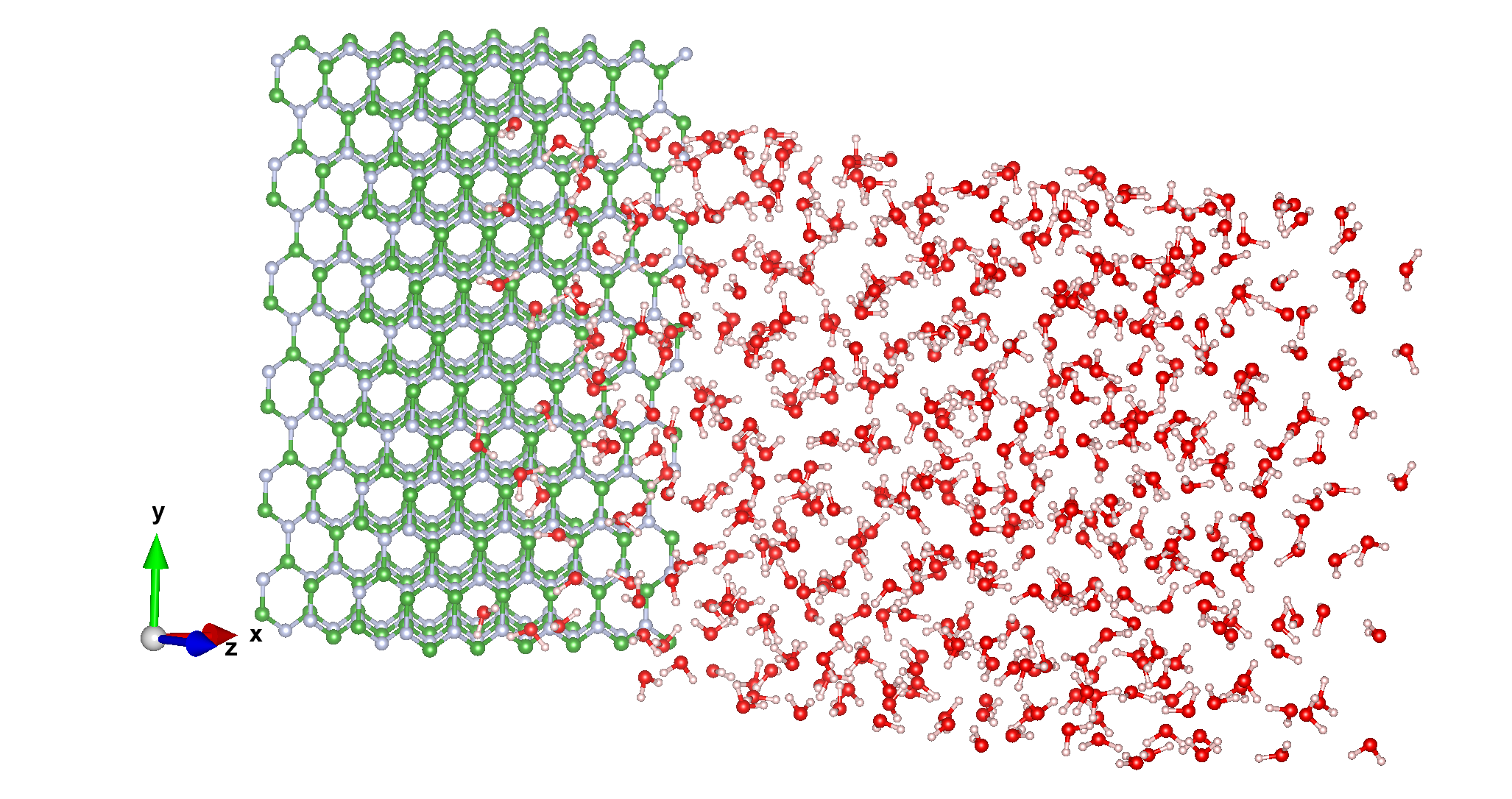
I ran succesful in running a very simple MD simulation where the interation of hBN (hexogonal Boron Nitride) and a liquid is shown (can you guess the liquid?). I must credit Prof Ananth of IISc who helped me setup this simulation.
This was the simulation side.
Now we must get into the practical side. How do we know that a given material follows the property as we intended from the simulations? For that we need to “see” the atoms and molecules
This is here X-ray diffraction, crytaloogaohy, sybcrtron light sources comes in.
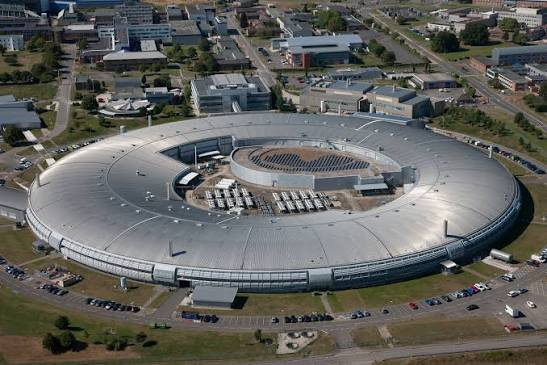
Below is an image of a syncrotron light source. The building is so shaped since it’s a partcle accelerator. Yes, the entire building is one giant machine.